Overview
A significant percentage of initial VA disability claim denials are later changed, corrected, or overturned through formal review and appeal processes.
These outcomes provide important insight into the accuracy of first-level adjudications and the effectiveness of existing quality controls.
Higher-Level Review & Supplemental Claims
Under the Appeals Modernization Act (AMA), veterans may request a Higher-Level Review or submit a Supplemental Claim with new evidence.
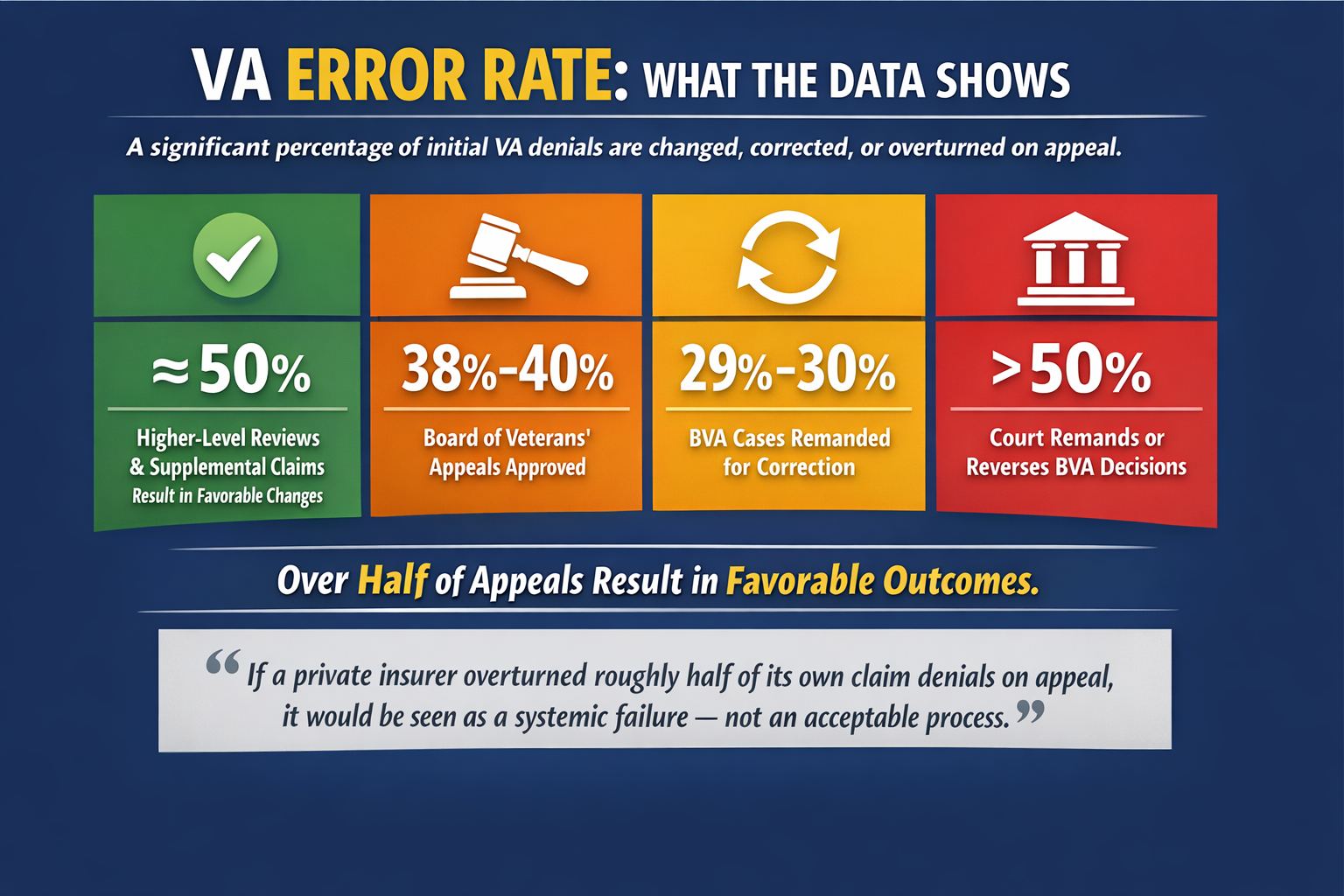
- Approximately 50% of Higher-Level Reviews and Supplemental Claims result in a favorable change (approval, increased rating, or corrected error), though results vary by year and claim type.
This indicates that roughly half of contested initial decisions do not withstand secondary review.
Board of Veterans’ Appeals (BVA)
When claims advance to the Board of Veterans’ Appeals, outcomes continue to reflect significant error rates.
- Approximately 38–40% of BVA appeals are granted outright.
- Approximately 29–30% of BVA cases are remanded to the VA due to identified errors or inadequate development.
Remanded cases are not final denials; they represent decisions found deficient and requiring correction.
Judicial Review (U.S. Court of Appeals for Veterans Claims)
Veterans may appeal Board decisions to the U.S. Court of Appeals for Veterans Claims.
- More than half of Board decisions reviewed on the merits by the Court are remanded or reversed.
These outcomes demonstrate that adjudicative errors persist even after multiple layers of review.
Key Takeaway
When approvals and remands are combined, a majority of appealed VA decisions result in favorable movement for the veteran—approval or correction. Imagine how much this could impove with the introduction of AI to the initial review process.
VA Error Rate — Visual Summary
References
- Board of Veterans’ Appeals Annual Reports (VA)
- U.S. Court of Appeals for Veterans Claims Annual Reports
- VA Appeals Modernization Act (AMA) outcome data
- Government Accountability Office (GAO) reports on VA disability claims accuracy
Note: Percentages vary by fiscal year and review lane. Figures shown reflect consistent multi-year patterns rather than a single-year snapshot.